
You cannot jump a course on day one — developing your skills
Portal Editorial Team · September 13, 2026
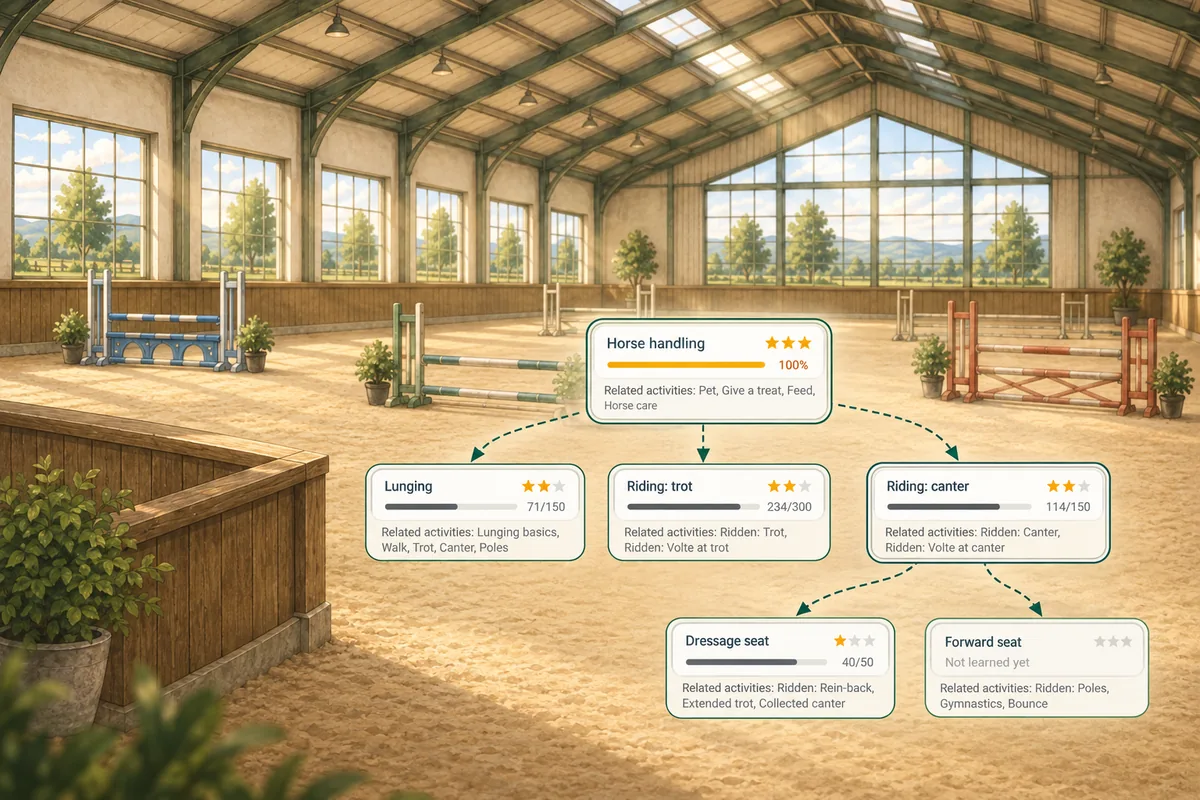
At the beginning, it is easy to watch more experienced riders and assume that the most important thing is simply to do more: ride more, train more often, and move to harder exercises as quickly as possible.
Riding does not work that way. Later skills grow from earlier ones, and skipping several stages usually leaves you without the foundations you need.
The EWO horse game works in much the same way.
Build the foundations first
Before you can ride, work a horse from the ground, or take on more advanced care, you need basic handling experience.
From there, the paths begin to branch. Walk leads to trot, trot to canter, and later you can develop towards dressage, jumping, or cross-country. Lunging opens the way to working with young horses and starting them under saddle.
That does not mean you need to learn everything.
If dressage interests you, there is little point in developing every possible jumping skill merely because it exists. If you want to work with young horses, strong lunging and handling skills will be more useful than another course exercise.
The simplest rule is: learn the things you genuinely intend to use.
Skills grow through practice
You do not gain most skills by reading instructions. You have to perform them.
Want to improve at lunging? Lunge horses. Want to feel more confident at the trot? Ride at the trot. Want to learn to pick out hooves? First master ordinary grooming.
Higher levels are not separate purchases. They result from experience gained while working with horses.
This has another important consequence: you cannot teach a horse beyond your own ability. If your skills stop at a particular level, a horse trained only by you will stop there as well. At that point, you need a more experienced trainer.
Some things require formal training
Practice alone is not enough for every skill.
You do not become a farrier simply by looking at many hooves. You cannot begin judging competitions without the proper qualification, or teach lessons merely because you ride well.
These skills require a course.
Courses take place at different locations depending on the specialisation. Some last one day; others require several visits. You need to enrol, pay the fee, and have enough energy to attend. Only after completing the course can you begin gaining practical experience in that profession.
Before enrolling, consider whether you truly want to follow that path. A course is the beginning of a specialisation, not its end.
If you do not know what to develop
At first, focus on a few things that are useful to almost every horse owner:
- confident handling and grooming,
- lunging,
- the basics of riding in all three gaits,
- skills connected with the direction in which you later want to train.
Later, you can decide whether you want to become a trainer, judge, farrier, veterinary technician, or simply an increasingly capable rider.
You do not have to know everything.
It matters far more that you can do your current tasks well enough to move safely to the next ones.